When work needs doing at height, the default answer on many sites is still to put up scaffolding. Sometimes that’s the right call. But for a lot of inspection, maintenance and repair jobs, rope access can get the work done faster, with less disruption and at a lower cost.
So how do you decide which is right for your job? Here’s a straightforward comparison.
What is industrial rope access?
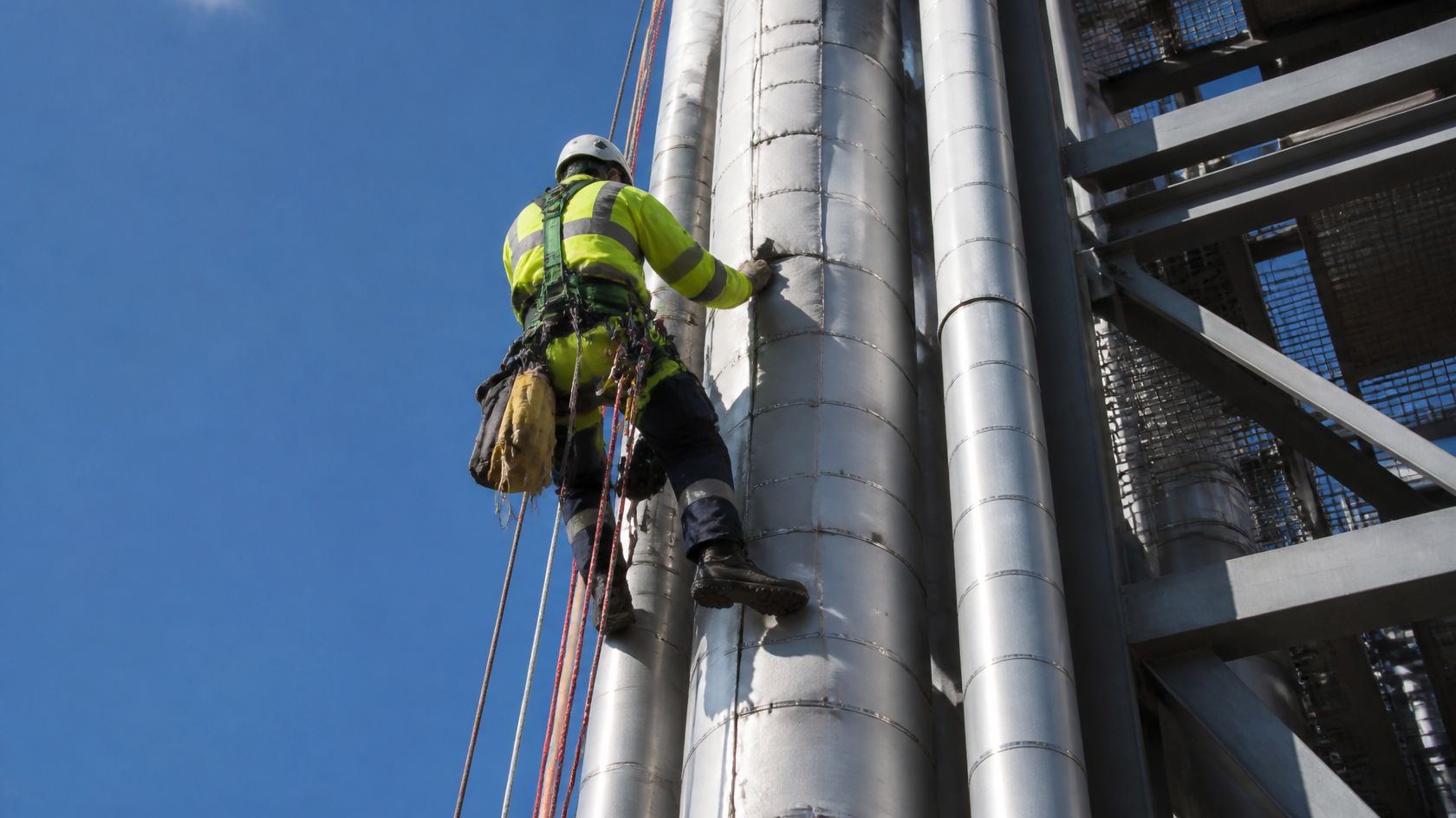
Industrial rope access is a way of working at height using ropes and specialist equipment. Technicians are suspended on two independent ropes: a working line and a backup safety line. If one fails, the other holds. It’s used on everything from tall pipe racks, chimneys and silos to building facades, bridges and offshore platforms.
In the UK, most industrial rope access follows the IRATA International system. Technicians are trained and certified at three levels:
- Level 1: carries out rope access work under supervision
- Level 2: an experienced technician who can rig ropes and carry out rescues
- Level 3: a rope access supervisor responsible for the work site, safety and rescue planning
Rope access vs scaffolding: how they compare
Speed
Scaffolding can take days, or even weeks, to design, erect, inspect and later dismantle. Rope access teams can usually rig up and start work within hours. For short jobs, this difference alone can decide it.
Cost
With rope access, there’s no scaffold hire, transport, erection or dismantling to pay for. Fewer people are usually needed on site, and the job is finished sooner. For many inspection and maintenance tasks, that adds up to a significant saving.
Disruption
Scaffolding takes up space, can block access routes and may need to stay in place for long periods. Rope access leaves a much smaller footprint, so the rest of the site can keep running around the work.
Safety
Rope access has a strong safety record when it’s carried out by trained, certified teams following IRATA procedures. Every job has a rescue plan, and technicians are trained to rescue each other. The Work at Height Regulations 2005 require you to choose the safest suitable method for each job, and for many tasks rope access is exactly that.
When scaffolding is the better choice
Rope access isn’t the answer to everything. Scaffolding is usually better when:
- The job is long-running and lots of trades need access at the same time
- Heavy materials or equipment need to be lifted and stored at height
- Work needs a large, stable platform, such as major structural repairs
- There’s no suitable anchor point for rigging ropes safely
On some projects, the best answer is a mix of both, with scaffolding where it’s essential and rope access everywhere else.
Jobs that are ideal for rope access
- Insulation and cladding repairs on high pipework, vessels and stacks
- Inspection and NDT at height
- Blasting, painting and coating repairs on steel structures
- Passive fire protection repairs in high or hard-to-reach areas
- Fitting and removing insulation jackets on elevated valves and flanges
- Surveys and condition reports where access would otherwise be costly
How AIC can help
AIC provides IRATA rope access as part of our industrial services. That means our rope access technicians can carry out insulation, coatings, inspection and repairs themselves, rather than just providing access for another contractor. One team, one mobilisation and no scaffold to pay for. We work on process plants, power stations, energy from waste facilities and commercial buildings across the UK.
Frequently asked questions
Is rope access safe?
Yes, when it’s carried out by trained and certified technicians following IRATA procedures. Two independent ropes, regular equipment checks and a rescue plan for every job keep the risk low.
Is rope access cheaper than scaffolding?
For many short and medium-length jobs, yes. You save on scaffold hire, erection and dismantling, and the work is often finished sooner. For long, multi-trade projects, scaffolding may still be more cost-effective.
What work can rope access technicians do?
Almost anything that doesn’t need heavy plant at height. Our technicians carry out insulation, cladding, coating, inspection and repair work while on ropes.
Can rope access be used in bad weather?
Light rain is usually fine, but high winds, lightning and severe weather will stop work for safety. The supervisor makes this call on the day.
Talk to AIC about your site
Got a job at height? Contact AIC to find out if rope access could save you time and money, and get a free, no-obligation quote.
Find out more about our rope access, thermal insulation and blasting and painting services, or read our guide: Removable Insulation Jackets for Valves and Flanges.
Contact AIC for a free, no-obligation quote or call 01642 689587.