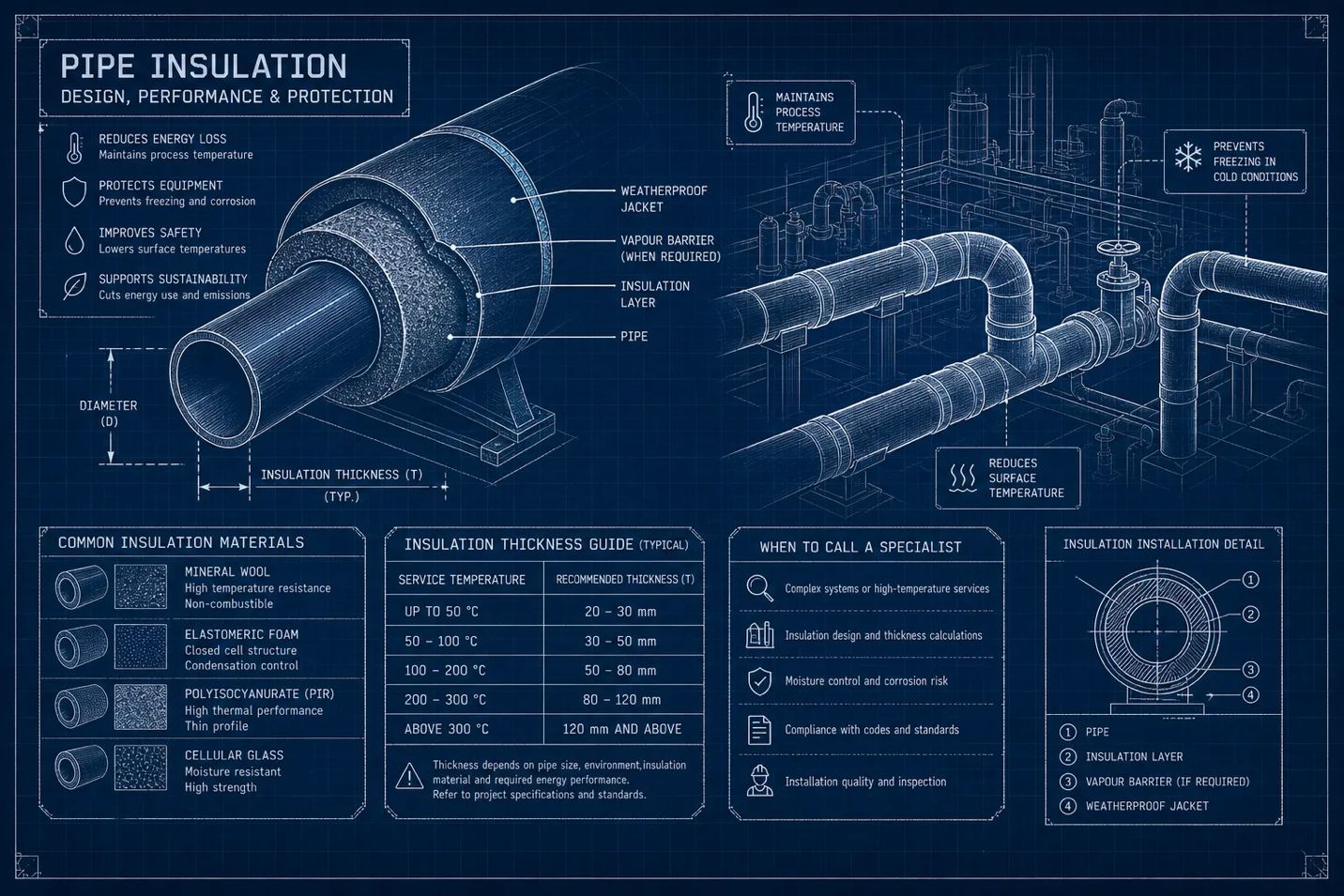
Uninsulated or poorly specified pipework is one of the most consistent sources of avoidable energy loss in industrial facilities, a pattern that industry energy audits and TIPCHECK assessments have documented repeatedly across sectors. Pipe insulation is not a passive afterthought fitted once and forgotten; it is a functioning component of a facility’s thermal system, and when it is wrong, everything that follows from that decision pays the price.
This guide covers what industrial pipe insulation actually does, which materials are used across sectors including petrochemical, food manufacturing, and power generation, how thickness is specified correctly using BS 5422, and why complex systems benefit from professional assessment rather than rule-of-thumb guesswork. Across these sectors, the same insulation failures come up repeatedly. Most are preventable with the right material and specification from the outset.
What pipe insulation actually does in an industrial setting
Pipe insulation is a thermal barrier fitted around a pipe to control the rate of heat transfer between the pipe contents and the surrounding environment. In industrial facilities, that function covers three distinct goals: keeping hot systems hot, keeping cold systems cold, and protecting process or utility pipework from freezing during periods of low ambient temperature. Each of these goals has direct consequences for energy costs, process quality, and operational safety.
The energy cost of uninsulated pipework at scale
Energy loss from bare or degraded pipework is not trivial at the scale of an industrial plant. A single 10-metre uninsulated pipe run can waste 200 to 400 kWh per year, and a large facility with hundreds of metres of steam and process pipework multiplies that figure significantly, on a complex site, an uninsulated steam line sheds heat continuously along its entire length, adding up to a measurable and entirely avoidable line on every energy bill. The financial case for pipe insulation is straightforward: reduced heat loss means less fuel consumed to maintain process temperatures, and that saving compounds across every hour the plant operates.
Process temperature control and freeze protection
Beyond energy savings, pipe insulation maintains the temperature stability that industrial processes require. In pharmaceutical plants, food manufacturing, and chemical processing, process fluids must be held within tight temperature bands; even minor variation can affect product quality, batch consistency, or regulatory compliance. Pipe insulation delays the rate of temperature change, reducing the load on any trace heating systems running alongside and providing a buffer against ambient temperature fluctuations.
In outdoor plant areas, utility pipework, including water lines, steam distribution, and instrument lines, is vulnerable to freezing during winter. Properly specified insulation does not eliminate freeze risk on its own, but it buys time and reduces the energy demand on heat-tracing systems that provide the primary freeze protection on exposed runs.
Common pipe insulation materials used across industrial sectors
No single material covers every application. The right choice depends on service temperature, pipe location, moisture exposure, fire performance requirements, and the sector’s regulatory expectations. Selecting a material by habit rather than by specification is one of the more reliable ways to produce underperforming insulation, degradation often becomes apparent within a few seasons, as documented in TIPCHECK audit findings across comparable sites.
Mineral wool and glass fibre for high-temperature systems
Mineral wool (rock wool) and glass fibre are the workhorses of high-temperature industrial pipework. Both tolerate service temperatures well above what elastomeric or polymer-based foams can handle, and mineral wool’s thermal conductivity sits in the 0.035 to 0.045 W/m·K range. Its inherent fire resistance makes it a natural fit for power generation, energy-from-waste, and petrochemical sites where fire risk is a design consideration, not an afterthought.
Mineral wool is typically supplied as pre-formed pipe sections for standard bore sizes, or as wired mattress rolls for irregular geometry, large-diameter vessels, and bespoke configurations where off-the-shelf sections are not practical. Pipe lagging using mineral wool remains the standard approach on high-temperature steam systems throughout UK industry.
Elastomeric pipe insulation for chilled services and process pipework
Elastomeric foam operates in the 0.033 to 0.038 W/m·K range and is defined by its closed-cell structure, which resists moisture vapour diffusion. That property makes it particularly suitable for chilled water pipework, HVAC systems, and refrigeration lines where condensation on cold surfaces is the primary concern. Armaflex is a widely recognised brand name in this category, though it describes a specific product rather than a unique material class. Elastomeric pipe insulation is available in pre-slit tubes and pipe insulation sleeves sized to suit standard pipe diameters, making it straightforward to fit on both new installations and retrofit projects.
Polyurethane foam, with conductivity around 0.029 to 0.032 W/m·K, delivers higher thermal performance in a thinner wall section. It is common on process pipework where space around the pipe is limited and the specification needs to meet a thermal target without adding significant bulk to the installation.
Phenolic and PIR foam where thin insulation is critical
PIR (polyisocyanurate) and phenolic foam sit at the high-performance end of the thermal conductivity table: PIR at approximately 0.021 to 0.026 W/m·K and phenolic foam at 0.020 to 0.025 W/m·K. These materials allow designers to meet the same thermal performance target with a thinner wall section, which matters in congested plant rooms, process racking, and pipework running through structural penetrations where space is genuinely constrained.
Both materials are more sensitive to mechanical damage than mineral wool or elastomeric foam and typically require protective metallic cladding in industrial installations. That additional step is worth accounting for in both cost planning and installation scheduling.
How insulation thickness is specified for industrial pipes
Thickness is not guessed or chosen from a catalogue based on what feels adequate. In the UK, the governing standard for pipe insulation specification is BS 5422, which provides a method for calculating the required insulation thickness based on pipe outer diameter, service temperature, ambient temperature, and the thermal conductivity of the chosen material. BS 5422 covers a service temperature range from -40°C to +700°C, spanning the full range of industrial applications from cryogenic systems through to high-pressure steam.
The variables that drive the calculation
The key inputs to any thickness calculation are the pipe outer diameter (which determines the surface area losing heat), the temperature differential between pipe contents and surrounding air, the thermal conductivity of the insulation material, and whether the primary goal is heat-loss reduction, freeze protection, or condensation control. These variables interact, which is why the same pipe in different locations on the same site can require different insulation specifications.
As a rough reference, domestic-scale pipes in unheated spaces typically need a minimum of 25 mm of insulation. Industrial pipes running at 150°C or higher require substantially greater thickness, and that calculation must be done using BS 5422 rather than drawn from general guidance tables designed for building services applications.
Why getting the thickness wrong has consequences
Under-specification produces excessive heat loss, process temperature instability, and the risk of freezing on utility lines. Over-specification wastes material cost and adds unnecessary weight to pipe supports, which has structural implications on heavily loaded pipe racks. The correct thickness is the one that meets the performance target with the appropriate material, nothing more and nothing less.
Where installation conditions fall outside the assumptions built into the BS 5422 tables, BS EN ISO 12241 provides the calculation methodology for those edge cases. A specifier who does not know that distinction exists is already working from an incomplete picture.
Where pipe insulation matters most across an industrial facility
Not all pipework on a site carries equal risk or energy significance. Identifying the highest-priority areas allows facilities managers and project teams to direct insulation investment where it delivers the greatest return and where failures are most likely to occur.
Steam lines, process pipework, and exposed outdoor runs
Steam distribution lines are among the highest-priority insulation targets on any industrial site. They operate at high temperatures, run long distances, and shed heat continuously along every uninsulated or degraded metre of their length. Process pipework carrying temperature-sensitive fluids, including reactants, intermediates, and finished products, needs stable thermal conditions for both quality and safety reasons.
Outdoor pipe runs face the additional challenge of wind-chill and ambient temperature extremes that accelerate heat loss and increase freeze risk significantly compared with indoor pipework. These runs deserve particular attention during any site survey, especially where they pass through unheated structures or are elevated above grade.
Pipe insulation sleeves and removable jackets for valves, flanges, and fittings
One of the most consistent insulation failures on industrial sites is not on the straight pipe runs. It is at valves, flanges, and tee junctions, where standard pre-formed sections cannot be fitted and where the pipework is most often left bare or covered with makeshift pipe wrap insulation that degrades quickly. In many TIPCHECK surveys, these points account for a disproportionate share of total heat loss relative to their surface area.
Removable insulation jackets and purpose-made flexible pipe insulation sleeves for valve bodies and flanged joints address this directly. They maintain thermal continuity across the full pipework system and allow maintenance access without requiring permanent insulation removal. In facilities audited against energy performance benchmarks, insulation jackets for valves and fittings are often among the fastest-payback investments on site, a finding consistent with published TIPCHECK audit outcomes.
Why industrial pipe insulation needs specialist assessment and installation
The materials, the specification standards, the access challenges, and the multi-zone complexity of large industrial facilities all point to the same conclusion: professional expertise is not optional on complex sites. It is the difference between an insulation system that performs to specification and one that degrades within a few seasons.
What a professional insulation survey identifies
A professional assessment goes well beyond measuring pipe diameters and selecting a material from a product sheet. It identifies degraded or missing insulation sections and assesses whether the existing specification still matches current operating conditions. It also checks for moisture ingress in closed-cell or mineral wool sections and evaluates heat loss against current energy costs, producing a clear financial case for remedial work ranked by return on investment.
The TIPCHECK energy audit methodology provides a structured, data-driven framework for exactly this kind of assessment. It combines on-site measurements, thermal imaging, and standardised calculations to quantify actual heat losses at pipes, valves, flanges, and fittings. The results are benchmarked against EN 17956 efficiency classifications and ranked by payback period and return on investment, so the highest-impact improvements are prioritised rather than addressed arbitrarily.
How specialist contractors manage complex industrial insulation projects
Complex facilities, including EfW plants, petrochemical sites, and pharmaceutical manufacturing environments, typically have pipework at height, in confined spaces, or in environments with strict safety classifications such as ATEX-designated zones. Contractors who combine insulation expertise with rope access capability, NDT inspection, and trace heating services assess and install across the whole system, removing the need for the facility to manage multiple separate vendors. That integrated approach reduces downtime, simplifies procurement, and produces a consistent insulation standard across the site.
AIC Ltd operates across precisely these sectors: power generation, petrochemical, food manufacturing, and pharmaceutical facilities where the technical demands are highest and the cost of getting the specification wrong is most significant. Delivering insulation, trace heating, rope access, and TIPCHECK energy auditing under one contractor relationship is a practical advantage that reduces the number of interfaces on every project and keeps accountability clear from survey through to handover.
Getting the specification right from the outset
Pipe insulation in industrial facilities is a specified, engineered system that directly affects energy costs, process stability, regulatory compliance, and operational safety. Selecting the right material for the service temperature and environment and calculating the correct thickness using BS 5422 are essential first steps. Ensuring that valves, flanges, and fittings are covered to the same standard as the straight runs is equally important. Each of these steps requires both technical knowledge and field experience to execute properly.
Facilities with ageing insulation, inconsistent specification across zones, or pipework that has been partially stripped and not reinstated after maintenance work should treat that condition as an active cost. A professional survey will quantify exactly what that cost is and identify where targeted investment delivers the fastest return. If your site has not had a structured insulation assessment in recent years, that is a good place to start. Contact AIC Ltd to discuss a TIPCHECK energy audit or a site-specific pipe insulation survey, and get a clear picture of where your facility stands.