Most facility managers first think about pipe lagging after a burst in a cold snap or when an energy audit reveals heat losses they had not accounted for. The logic seems simple enough: wrap the pipe, job done. In practice, the gap between fitting something and fitting the right thing is wider than it looks. Whether you are insulating a loft run in a domestic property or specifying thermal pipe insulation across a pharmaceutical processing plant, the core principle is the same. The material, thickness, and installation standard, however, are not. This article covers what pipe lagging is, when your building or facility genuinely needs it, how to measure and select the right product, and where professional assessment is worth every penny. Across industrial sectors especially, that last point matters: a specialist contractor does not just apply a product, they verify the specification is correct for the service conditions and the compliance requirements in play.
What pipe lagging actually is (and how it differs from regular insulation)
The basic thermal principle behind it
Pipe lagging reduces the rate of heat transfer between the fluid inside a pipe and the surrounding environment. On hot water and heating pipes, it keeps heat in the pipe where it belongs rather than losing it to the surrounding air. On cold water and chilled service lines, it works in the other direction: it prevents warm ambient air from raising the pipe surface temperature, which is what causes condensation and, in exposed locations, freezing. Insulating material creates a thermal barrier that slows the exchange of energy. The lower the material’s thermal conductivity, the more effective that barrier is for a given thickness, which is why pipe insulation thickness is a critical variable in any specification, not an afterthought.
How it differs from general pipe insulation
In everyday usage, “pipe lagging” and “pipe insulation” are treated as interchangeable, and in domestic contexts they largely are. The distinction matters more in industrial and commercial settings. Pipe insulation is the broad category covering any material used to thermally protect a pipe. Pipe lagging specifically refers to the applied product, the pre-formed sleeve, wrap, or jacket that fits directly over the pipe exterior. In industrial specifications, “lagging” carries additional connotations around the installation standard, the cladding system over the insulation, and the performance requirements that the finished assembly must meet. If someone tells you a pipeline is “lagged,” that says something more precise than “a bit of foam has been fitted.”
When your building or facility actually needs it
Domestic and light commercial scenarios
The most common domestic triggers are pipework in unheated spaces: loft runs, external walls, garages, and under-floor voids. Any pipe running through a space that regularly approaches or falls below freezing is at risk without adequate insulation, a threshold referenced in BS 5422 and Approved Document L guidance on freeze protection. Beyond freeze protection, hot water and heating pipes in unheated areas lose heat continuously, pushing up energy consumption over the course of a year. Condensation on cold water and chilled lines is a lesser-known issue but a genuine one, particularly in humid plant rooms and basements. For these scenarios, off-the-shelf foam pipe insulation sleeves from a builders’ merchant handle the job well. A competent DIYer with basic tools can complete most domestic pipe wrapping in a day, though the time will vary depending on system complexity and the number of fittings involved.
Industrial pipework where the stakes are higher
In oil and gas, pharmaceutical manufacturing, power generation, and energy-from-waste facilities, the question is never simply “does this pipe need lagging?” The relevant questions are more specific:
-
What operating temperature is the line running at?
-
What is the ambient environment?
-
What are the regulatory compliance requirements?
-
What pipe insulation thickness of which material is mandated to meet the energy efficiency target or personnel protection standard?
Inadequate lagging on a high-temperature process line is not just an energy issue. It can create burn risk for personnel, accelerate corrosion under insulation, or cause process temperature to fall outside specification. For complex, multi-service plant environments, a specialist industrial insulation contractor brings the engineering knowledge to assess these requirements systematically rather than applying a best-guess solution.
Pipe insulation options: what the main materials are and when to use each
Foam pipe insulation for everyday pipework
Polyethylene foam and polyurethane foam are the standard choices for domestic and light commercial applications. Their thermal conductivities typically fall in the 0.024–0.036 W/m·K range, which is more than adequate for domestic hot water and heating lines. Pre-split foam lagging sleeves, the type you press open and snap onto the pipe, are the most widely available retail format. Phenolic foam offers better thermal performance at around 0.021–0.025 W/m·K and is a sensible choice where pipe runs are in tight spaces and a thinner wall is needed to achieve the same thermal resistance. It costs more, but for commercial plant rooms where space constraints matter, the improved lambda value justifies the difference.
Rubber and mineral wool for demanding conditions
Nitrile and EPDM-based elastomeric rubber foam is the material of choice for chilled water pipework and refrigeration lines. Its thermal conductivity is similar to standard foam at roughly 0.036 W/m·K, but its vapour resistance is the critical property. It prevents moisture from migrating through the insulation and condensing on the cold pipe surface, a process that would saturate fibrous materials and destroy their performance over time. Mineral wool, whether glass or rock wool, is the go-to for high-temperature industrial service. Standard pipe sections handle continuous service up to approximately 250°C, with specialist products extending that range further; exact limits vary by manufacturer and product grade, so always verify against the relevant datasheet. Where fire resistance is a hard requirement, mineral wool’s non-combustibility, rated Euroclass A1 under EN 13501-1, is a decisive factor. For industrial plant environments, external pipe lagging in mineral wool or phenolic foam must be specified to a recognised standard, not simply selected from a retail shelf.
Measuring and sizing lagging sleeves correctly
How to measure outside diameter accurately
The most common sizing error is specifying lagging to the pipe’s nominal bore rather than its outside diameter, resulting in sleeves that will not seat correctly. Lagging sleeves are sized to the pipe’s outside diameter, not the internal bore. If the pipe end is accessible, measure across it with callipers. If it is not, wrap a flexible tape or piece of string around the pipe, note the circumference, and divide by 3.14159 to get the outside diameter. When you look at product labels, the notation “15/13” means a sleeve sized for a 15mm bore pipe with a 13mm wall thickness. That 15mm refers to the nominal bore used in plumbing specification, but the sleeve is manufactured to fit the corresponding outside diameter, which for copper 15mm pipe is 15mm OD. For different pipe materials, the OD varies slightly even at the same nominal size, so always confirm the actual outside diameter before purchasing.
Recommended pipe insulation thickness by location
Approved Document L and BS 5422 together provide a practical framework for domestic and light commercial applications. As a guide, 13mm wall thickness suits pipes in internal heated spaces; 25mm is appropriate for unheated spaces such as loft voids and garages; and 32mm is recommended for external or exposed pipework where freeze protection is the primary concern. The table below summarises these reference values:
| Location | Recommended pipe insulation thickness |
|---|---|
| Internal heated space | 13 mm |
| Unheated space (loft, garage) | 25 mm |
| External / exposed pipework | 32 mm |
| Commercial hot water / heat network secondary pipework (CIBSE CP1) | 50 mm minimum (phenolic or mineral fibre) |
For commercial hot water systems and heat networks, CIBSE CP1 references minimum thicknesses of 50mm for phenolic and mineral fibre insulation on secondary pipework. Industrial process pipework carries its own specification requirements driven by operating temperature, ambient conditions, and energy efficiency targets. Those requirements are determined through engineering calculation under BS 5422:2023, which covers service from −40°C to +700°C, they are not derived from domestic thickness tables.
Fitting pipe lagging: a practical overview and when to bring in a specialist
The basics of fitting foam lagging sleeves
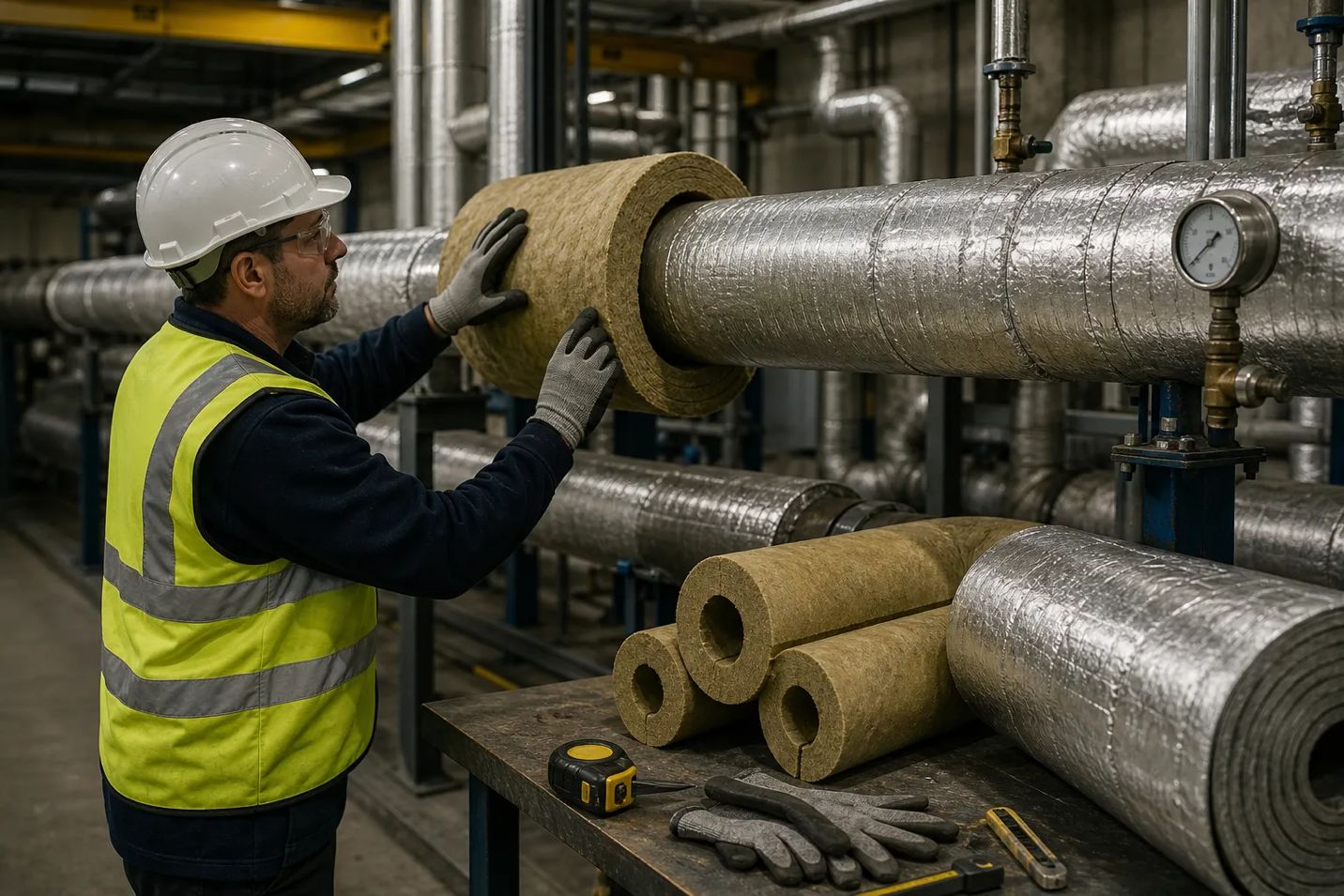
For standard domestic pipework, the fitting sequence is straightforward. Start with the pipe surface clean and dry. Cut straight sections to length with a sharp knife and press the pre-split sleeve onto the pipe, sealing the seam with tape or the adhesive strip where provided. Butt adjacent sections together with no gap and tape over each joint to maintain a continuous thermal barrier. For 90-degree bends, cut each piece at 45 degrees so the two mitred faces meet at the curve; on copper pipe, clean mitres and tight taping are more important than on plastic, which has more flex. At tee junctions, mark the branch position on the main-run insulation, cut a saddle opening to receive the branch piece, and tape all edges thoroughly. Check the finished run for any gap or uninsulated fitting before calling it done, gaps are where cold bridges form and heat loss concentrates.
When a professional assessment and installation is the right call
The domestic tasks above are reasonable for a competent homeowner or maintenance operative. Industrial plant pipework is a different matter entirely. High process temperatures, pressurised systems, potential exposure to flammable or hazardous materials, and mandatory compliance with BS 5422, Approved Document L, and sector-specific standards all place industrial lagging work firmly in specialist territory. The consequences of getting it wrong extend well beyond energy loss. Inadequate thermal pipe insulation on a process line can mean process failure, corrosion under insulation that goes undetected for years, or personnel exposure to surface temperatures that exceed safe limits.
For facilities in oil and gas, pharmaceutical manufacturing, power generation, or energy-from-waste, a specialist industrial insulation contractor with genuine multi-sector experience is the right starting point. AIC Ltd works across these environments, assessing lagging requirements across complex, multi-service plant layouts and specifying the correct material, thickness, and installation standard for each service line.
What pipe lagging costs and where to buy it in the UK
Typical UK retail prices by type and size
Standard foam lagging sleeves for 15–28mm bore pipes run at approximately £0.77–£1.50 per metre at retail, inclusive of VAT. Thicker wall foam products and larger bore sizes rise to around £2–£3/m. Nitrile rubber lagging for chilled pipework typically costs £3–£8/m depending on pipe size and wall thickness. Mineral wool pipe sections start at roughly £4–£10/m for standard domestic and light commercial sizes, rising considerably for larger bore industrial sections. These figures represent domestic and light commercial retail pricing for 2026 based on trade and retail market data; prices are shown inclusive of VAT where applicable and should be confirmed with suppliers at the point of order. Industrial lagging is procured through specialist insulation distributors and priced to specification, comparing a domestic foam sleeve to an industrial mineral wool and cladding system on a cost-per-metre basis misses the point entirely.
Where to buy in the UK
For standard foam products, builders’ merchants and trade counters, including major national names such as Screwfix, Toolstation, and Travis Perkins, stock the most common bore sizes and wall thicknesses; confirm availability for your specific size before ordering. For bulk orders or less common sizes, online suppliers offer a broader range at competitive per-metre prices. Specialist insulation distributors carry industrial-grade mineral wool sections from manufacturers such as Rockwool, Knauf, and Paroc, alongside phenolic foam products such as Kingspan Kooltherm, for commercial and industrial applications. For facilities in regulated industries, procurement typically runs through the insulation contractor rather than directly through a distributor. The contractor takes responsibility for specifying the correct product, sourcing it to the required standard, and installing it in a way that can be verified against the project specification.
The bottom line on pipe lagging
Pipe lagging is a straightforward concept with a wide application range. The underlying principle, reduce heat transfer, protect the pipe, meet the required standard, applies equally to a domestic cylinder jacket and a high-temperature petrochemical line. The complexity and the consequences scale significantly as you move from a loft pipe run to an industrial plant environment. For domestic and light commercial work, selecting the right foam pipe insulation or specialist rubber product, confirming the correct pipe insulation thickness for the location, and fitting it carefully is a task most competent people can complete. The guidance in this article gives you the framework to do that confidently.
For industrial facilities, the lagging specification sits within a broader engineering and compliance picture that goes well beyond selecting a product from a merchant. Operating temperatures, regulatory standards, energy efficiency targets, and personnel protection requirements all drive the specification, and getting any one of them wrong carries real operational and financial consequences. If your facility operates in oil and gas, pharmaceutical manufacturing, power generation, or energy-from-waste, speak to a specialist industrial insulation contractor before committing to a specification. Contact AIC Ltd to discuss your requirements or find out more about our industrial insulation services.
Frequently asked questions about pipe lagging
What thickness of lagging do I need?
For domestic pipes in unheated spaces such as loft voids and garages, 25mm wall thickness is the standard recommendation under BS 5422 and Approved Document L. Internal heated spaces typically require 13mm, and external or exposed pipework 32mm. Commercial and industrial applications require engineering calculation to determine the correct pipe insulation thickness, domestic tables do not apply.
Can I fit pipe lagging myself?
For standard domestic pipework, yes. Pre-split foam lagging sleeves are designed for straightforward self-installation with basic tools. Industrial pipework, including pressurised systems, high-temperature lines, and any installation subject to regulatory compliance standards, should be specified and fitted by a qualified insulation contractor.
What is the difference between foam pipe insulation and rubber lagging?
Foam pipe insulation (polyethylene or polyurethane) is the standard choice for hot water and heating pipes. Rubber lagging (nitrile or EPDM elastomeric foam) is preferred for chilled water and refrigeration lines because of its superior vapour resistance, which prevents condensation forming on the cold pipe surface and degrading the insulation over time.